Skip to content
Fizyoterapist Aydın AliFizyoterapi & Rehabilitasyon

Ankylosing Spondylitis Exercise and Physiotherapy in Bursa

Ankylosing spondylitis is an inflammatory rheumatic condition affecting primarily the spine and the sacroiliac joints. Its distinguishing feature is that pain eases with movement rather than rest — the opposite of mechanical back pain. Here exercise is not a supplement but a component at the centre of treatment; international guidelines explicitly recommend regular exercise alongside medication. In Bursa Nilüfer, Fizyoterapist Aydın Ali delivers a mobility-focused programme that complements the treatment your doctor is running.

When is it needed?

  • Morning stiffness lasting more than thirty minutes
  • Back pain that increases with rest and eases with movement
  • Pain that wakes you in the second half of the night
  • Alternating pain in the hips and buttocks
  • Spinal range of motion reducing over time
  • Restricted chest expansion and difficulty breathing deeply

What we do

  • Baseline assessment with range of motion and chest expansion measurements
  • A daily exercise programme that protects spinal mobility
  • Posture and trunk extension work
  • Breathing and rib cage mobility exercises
  • Strengthening and aerobic work adjusted to tolerance
  • Manual techniques during painful periods where appropriate
  • Follow-up in collaboration with your rheumatologist

Ankylosing Spondylitis in Bursa Nilüfer

Fizyoterapist Aydın Ali provides one-to-one care for ankylosing spondylitis at the clinic in Bursa Nilüfer — in Fethiye Mahallesi, on Kelebek Sokak, at a central point of Nilüfer, opposite the Fethiye covered market.

It is a short trip by car or public transport from İhsaniye, Odunluk, Balat, Özlüce, Ataevler, 23 Nisan and the surrounding areas. Every session is one-to-one, assessment-based and tailored to you.
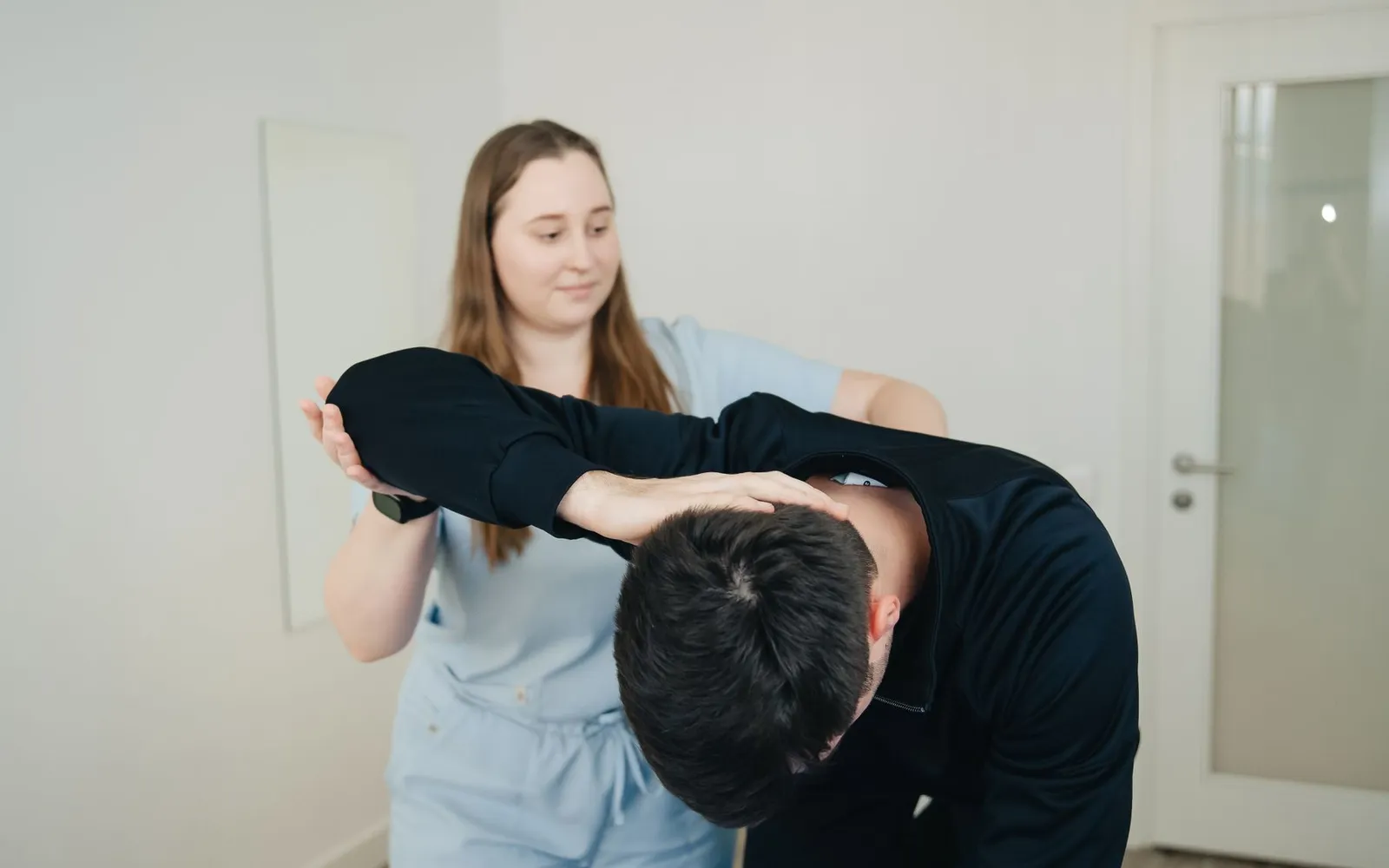

If your pain increases with rest and eases with movement

This one sentence is the most important clue that tells ankylosing spondylitis apart from ordinary low back pain. Mechanical low back pain increases with movement and eases with rest; inflammatory low back pain does the opposite. Add morning stiffness lasting over half an hour and pain that wakes you in the second half of the night, and the picture becomes quite clear.

Fizyoterapist Aydın Ali recognises this symptom pattern and refers to a rheumatologist if no diagnosis has been made yet — early diagnosis directly affects the outcome in this disease. Once diagnosed, physiotherapy comes in as a component that complements the physician's treatment; what matters is consistency, not intensity.

Why exercise sits "at the centre of treatment"

In ankylosing spondylitis inflammation can lead over time to stiffening of the spinal joints. A spine that keeps its mobility through this process is in a far better position than one trying to regain what it has lost — recovering lost range is not always possible.

Exercise here is therefore not something done once the pain settles. International guidelines recommend regular exercise alongside medication as an inseparable part of treatment. What decides the outcome is not intensity but consistency.

Which direction is trained?

The condition pushes the spine towards a forward-bent posture. The programme therefore works largely in the opposite direction: trunk extension, opening the chest, shoulder girdle and hip flexor flexibility. The aim is to use daily exactly those movements most likely to be lost.

Rib cage mobility is a separate heading. When the rib joints are affected, deep breathing becomes restricted; breathing exercises are therefore not decoration but a measured component — chest expansion distance is tracked regularly.

What happens during flare-ups?

The condition runs in flares and quiet periods. Stopping exercise entirely during a flare makes returning harder afterwards; forcing through it increases symptoms. The right approach is to lower the dose and preserve continuity.

The programme is therefore planned in two tiers: a quiet-period programme and a reduced version for flares. You are taught to recognise which applies from your own symptoms.

Diagnosis and medication belong to your doctor

Ankylosing spondylitis is diagnosed by a rheumatologist through examination, blood tests and imaging. All medical decisions, medication included, belong to your doctor; physiotherapy complements that treatment and does not replace it.

In young adults with long-standing back pain that does not ease with rest and wakes them at night, this diagnosis should be considered. When Fizyoterapist Aydın Ali recognises that symptom pattern in someone not yet diagnosed, a referral is made — early diagnosis directly affects outcomes in this condition.

5.0 · 22 Google reviews

Book a one-to-one assessment for ankylosing spondylitis

Fizyoterapist Aydın Ali · Bursa Nilüfer. Share your complaint; we plan the process together after the assessment.

Frequently asked questions

Does exercise increase the inflammation?

No. Appropriately dosed exercise has been shown to reduce pain and stiffness and to protect mobility. Intensity is lowered during flares, but the programme is not abandoned.

Does swimming help?

It usually suits this condition well: joint loading is low and it supports trunk extension. Even so it is not enough on its own and should run alongside targeted mobility and posture exercises.

How often should I exercise?

Consistency matters more than intensity here. A short daily programme produces better results than one long weekly session. The programme is planned around that reality, so that it is sustainable in daily life.

Does my sleeping position matter?

It does. A firm mattress, a thin pillow and lying as flat as possible support posture, while always sleeping curled on your side reinforces the forward-bent position. The details are discussed individually at the assessment.

Other treatments

  • Low Back Pain

    For back pain that persists without a clear imaging finding: a programme that looks for the source.

  • Back Pain

    For pain settling between the shoulder blades that builds through the day: a programme aimed at the source.

  • Herniated Disc

    An exercise-based, one-to-one physiotherapy programme for back pain and pain radiating into the leg.

Articles on this topic

  • Bel bölgesinin fizyoterapist tarafından değerlendirilmesi

    Spinal Health

    Which Department Should You See for a Herniated Disc?

    "Which doctor should I see for a herniated disc?" is one of the most common questions. The answer isn't a single department; it depends on the clinical picture.

    6 September 2026 · 3 min read

  • Bel ağrısı yaşayan kişi

    Spinal Health

    Who Decides on Surgery for a Herniated Disc, and How?

    The surgery decision for a herniated disc isn't left to one person or one MRI image. Whose hands is the process in, and what stages does it go through?

    5 September 2026 · 2 min read

  • Sırt kaslarına uygulanan masaj

    Spinal Health

    What Helps Back Pain?

    Most back pain isn't due to a serious disease — it's due to loading and posture. The good news: it eases with the right approach.

    4 September 2026 · 2 min read

Book an appointment for Ankylosing Spondylitis

The appointment form does not ask for health information; details are discussed by phone.

Book an appointment