Skip to content
Fizyoterapist Aydın AliFizyoterapi & Rehabilitasyon

Piriformis Syndrome Treatment in Bursa

The piriformis is a small muscle deep in the buttock, and the sciatic nerve passes directly beneath it (through it, in some people). When this muscle becomes tight or overworked it can press on the nerve and produce pain radiating down the leg, much like a disc herniation. The distinguishing clue is usually this: the pain starts not in the back but deep in the buttock, and increases markedly with long sitting. In Bursa Nilüfer, Fizyoterapist Aydın Ali begins with an assessment that makes exactly this distinction.

When is it needed?

  • Dull, one-sided pain deep in the buttock
  • Marked increase with long sitting, especially on a hard surface
  • Pain spreading down the back of the leg
  • Symptoms worse with a wallet in the back pocket
  • Difficulty crossing the legs
  • Pain increasing while driving and on long journeys

What we do

  • Assessment distinguishing a back origin from a hip origin
  • Neurological examination to rule out nerve root involvement
  • Manual therapy for the piriformis and deep hip muscles
  • Trigger point techniques
  • Strengthening the hip external rotators and abductors
  • Sciatic nerve gliding exercises
  • Sitting setup, driving position and break planning

Piriformis Syndrome in Bursa Nilüfer

Fizyoterapist Aydın Ali provides one-to-one care for piriformis syndrome at the clinic in Bursa Nilüfer — in Fethiye Mahallesi, on Kelebek Sokak, at a central point of Nilüfer, opposite the Fethiye covered market.

It is a short trip by car or public transport from İhsaniye, Odunluk, Balat, Özlüce, Ataevler, 23 Nisan and the surrounding areas. Every session is one-to-one, assessment-based and tailored to you.
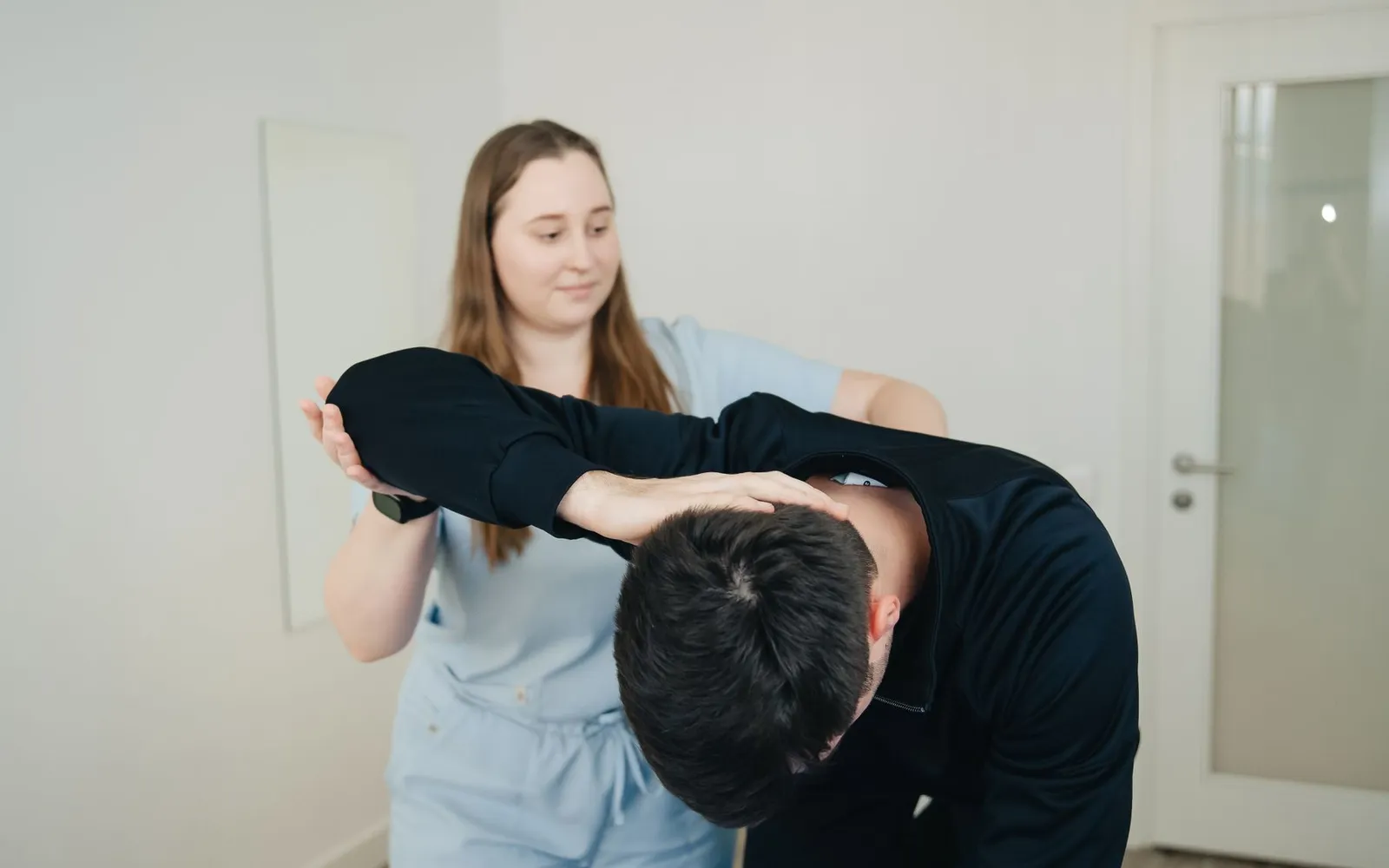

If the pain starts deep in the hip, not the back

Where pain spreading down the leg starts is the strongest clue to its source. Pain starting in the back and increasing on forward bending suggests a disc; pain starting deep in the hip and becoming pronounced with prolonged sitting may be piriformis-related. The two don't get the same programme.

Fizyoterapist Aydın Ali starts the process with this distinction and rules out nerve-root findings through neurological examination. Pain is brought under control with manual therapy and trigger-point work; the lasting part is strengthening the hip's side muscles, because the muscle produces pain not because it's tight but because it's overworked.

How is it told apart from a disc herniation?

Both produce pain radiating down the leg, which is why they are often confused. With a disc herniation the pain usually starts in the back, increases with bending forward and coughing, and may be accompanied by numbness or weakness in the foot. In a piriformis-related picture the pain starts deep in the buttock, increases with long sitting, and neurological examination is typically normal.

This distinction changes the programme directly: one leads with directional work for the spine, the other puts hip strengthening at the centre. A misclassified picture will not progress even with well-executed exercise.

Why stretching often is not enough

The first instinct in piriformis syndrome is to stretch the muscle, and stretching does bring relief in the moment. But the muscle is usually tight because it is overworking, not because it is short. When the large muscles on the side of the hip are weak, stabilising the pelvis during walking and standing falls to this small muscle.

In that situation stretching amounts to telling an overworked muscle to relax. The lasting difference comes from strengthening the hip muscles that should be carrying the load.

The sitting setup is no coincidence

The most commonly reported trigger here is prolonged sitting — particularly on a hard surface, leaning to one side, or with a wallet in the back pocket. Long periods of driving have the same effect; the side working the accelerator is often the symptomatic side.

The programme therefore does not stop at exercise. Seating surface, break frequency and in-car position are adjusted concretely; without those changes the effect of exercise stays limited.

The difficulty of diagnosis

There is no single test or imaging finding that confirms piriformis syndrome on its own; the diagnosis is made by ruling out other causes of similar symptoms. This deserves saying honestly, because the sacroiliac joint, the hip joint itself and the lower back can all produce the same pain.

Fizyoterapist Aydın Ali therefore keeps the assessment broad and builds the programme on measured findings rather than a single label. If the expected response does not come within the expected time, the diagnosis is revisited.

5.0 · 22 Google reviews

Book a one-to-one assessment for piriformis syndrome

Fizyoterapist Aydın Ali · Bursa Nilüfer. Share your complaint; we plan the process together after the assessment.

Frequently asked questions

Can I release it myself with a tennis ball?

Brief, gentle work relieves symptoms for most people. But because the sciatic nerve passes right through that region, prolonged hard pressure can increase numbness. Duration and intensity are decided together at the assessment.

What should I do while sitting?

Taking the wallet out of your back pocket, using a thin cushion on hard surfaces and standing briefly every 30-45 minutes make a noticeable difference for most people.

Can I keep running?

In most cases yes, with volume and surface adjusted. Hills and long distances usually aggravate symptoms; these details are set individually at the assessment.

My MRI showed nothing — is my pain not real?

Your pain is real. Piriformis syndrome typically produces no imaging finding; the diagnosis is made by examination and by ruling out other causes. Nothing showing on a scan does not mean there is no muscular problem.

Other treatments

  • Sciatica

    For pain travelling from the back into the hip and leg: assessment that identifies the source, then graded exercise.

  • Hip Pain

    For groin, outer hip and deep buttock pain: assessment that finds the source, then strength-focused work.

  • Low Back Pain

    For back pain that persists without a clear imaging finding: a programme that looks for the source.

Articles on this topic

  • Bel bölgesinin fizyoterapist tarafından değerlendirilmesi

    Spinal Health

    Which Department Should You See for a Herniated Disc?

    "Which doctor should I see for a herniated disc?" is one of the most common questions. The answer isn't a single department; it depends on the clinical picture.

    6 September 2026 · 3 min read

  • Bel ağrısı yaşayan kişi

    Spinal Health

    Who Decides on Surgery for a Herniated Disc, and How?

    The surgery decision for a herniated disc isn't left to one person or one MRI image. Whose hands is the process in, and what stages does it go through?

    5 September 2026 · 2 min read

  • Sırt kaslarına uygulanan masaj

    Spinal Health

    What Helps Back Pain?

    Most back pain isn't due to a serious disease — it's due to loading and posture. The good news: it eases with the right approach.

    4 September 2026 · 2 min read

Book an appointment for Piriformis Syndrome

The appointment form does not ask for health information; details are discussed by phone.

Book an appointment