Skip to content
Fizyoterapist Aydın AliFizyoterapi & Rehabilitasyon

Heel Spur and Plantar Fasciitis Treatment in Bursa

The most common cause of heel pain is an overloaded plantar fascia — the thick band running from the heel bone to the toes. The "spur" seen on an X-ray is usually a record of years of loading rather than the source of the pain: plenty of people have a spur and no pain at all, and plenty have pain with no spur. The goal is therefore not to remove anything visible on a film, but to raise the tissue's capacity above the load it has to carry. Fizyoterapist Aydın Ali combines pain-reducing treatment with progressive loading in Bursa Nilüfer.

When is it needed?

  • Sharp heel pain on the first steps after getting out of bed
  • Pain returning when standing up after a long period of sitting
  • Discomfort that eases while walking and returns towards the evening
  • Marked tenderness on the inner-lower edge of the heel
  • Dull pain that makes long standing or walking difficult
  • Tight calf muscles and difficulty pulling the foot upwards

What we do

  • Assessment of foot structure, gait and loading pattern
  • ESWT (shockwave) — among the best-supported options in chronic plantar fasciitis
  • Stretching programme for the plantar fascia and calf
  • Heavy, slow calf and intrinsic foot strengthening
  • Footwear, insole and daily standing-time adjustments
  • Taping for temporary load sharing where appropriate
  • A written home programme with regular re-measurement

Heel Pain in Bursa Nilüfer

Fizyoterapist Aydın Ali provides one-to-one care for heel pain at the clinic in Bursa Nilüfer — in Fethiye Mahallesi, on Kelebek Sokak, at a central point of Nilüfer, opposite the Fethiye covered market.

It is a short trip by car or public transport from İhsaniye, Odunluk, Balat, Özlüce, Ataevler, 23 Nisan and the surrounding areas. Every session is one-to-one, assessment-based and tailored to you.
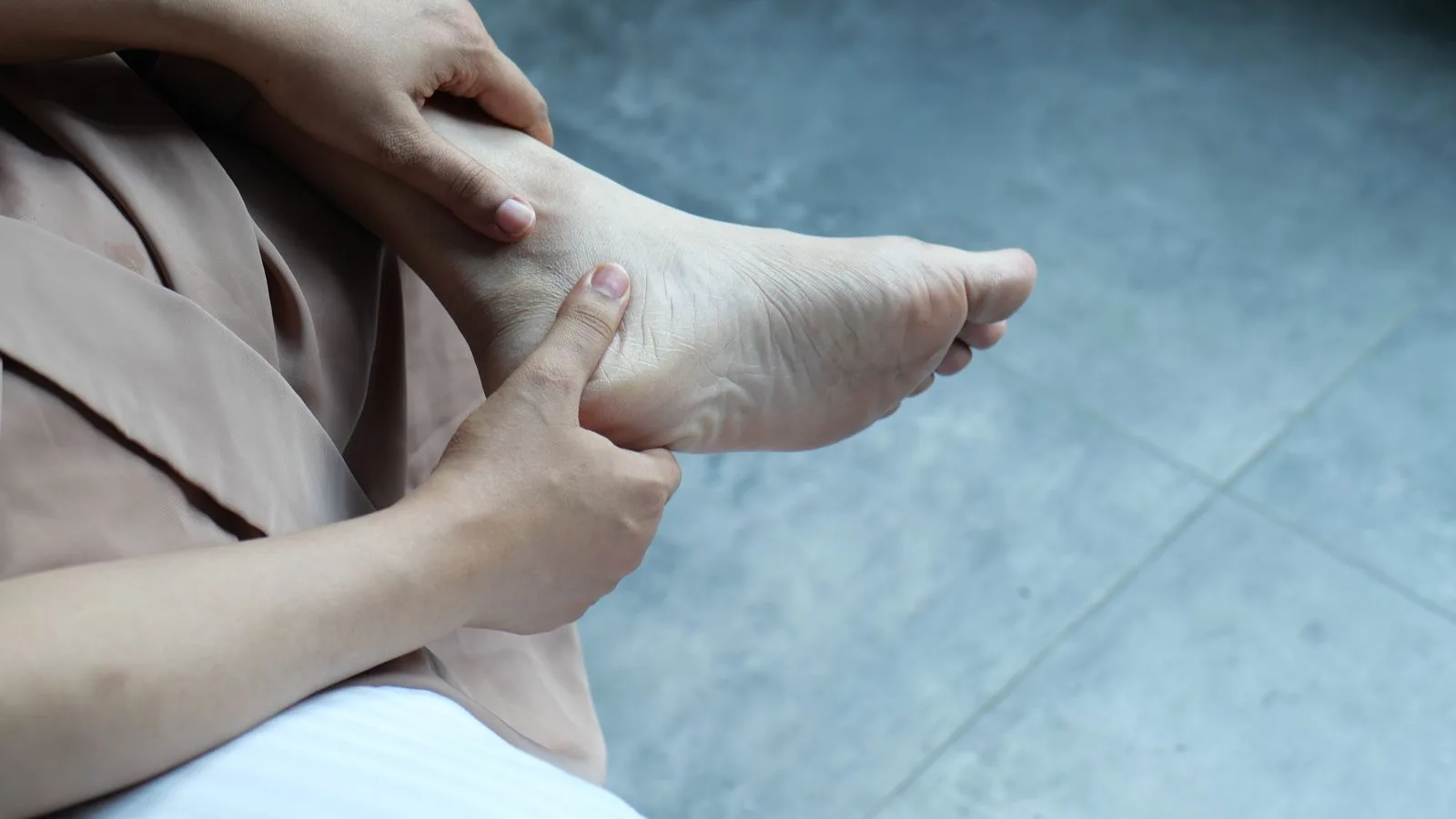

If it strikes on the first step in the morning and eases through the day

When heel pain increases tells a lot about its source. Pain that's sharp on the first step in the morning and eases with walking points to the plantar fascia; pain that stays constant all day or increases at night suggests a different condition and changes the direction of the programme.

Fizyoterapist Aydın Ali starts the assessment with this distinction, then measures the tender point and calf tightness. Load is reduced with manual therapy and, where suitable, ESWT during the painful period; the lasting part is stretching and graded strengthening. A spur seen on X-ray doesn't decide the treatment on its own.

Why the spur is not the cause

A heel spur is a small bony outgrowth that forms under the heel bone over years. Because it stands out clearly on an X-ray it is often assumed to explain the pain — yet in large imaging studies a substantial proportion of people with no heel pain at all have one. What hurts is the plantar fascia being loaded beyond what it can currently tolerate.

Knowing this changes the treatment directly: the aim is to raise the tissue's capacity above the demand placed on it, and that only happens through measured, progressive loading.

When does shockwave (ESWT) come in?

If symptoms have lasted several months and have not settled with rest and stretching, ESWT becomes relevant. Shockwave creates a controlled stimulus in the tissue that restarts the healing response, and it is one of the most studied options in chronic plantar fasciitis.

It is not a stand-alone fix, though. If strengthening does not run alongside it, symptoms tend to return as soon as normal load resumes — which is why the programme always contains both.

Load management, not rest

"Rest your foot" brings short-term relief and long-term trouble: unloaded tissue weakens further, and the pain restarts from the same place once normal activity returns. Neither complete rest nor pushing through is the right answer.

Daily step count, standing time, footwear and any running volume are reviewed together; a level that keeps pain below an agreed threshold is set and then raised in measured steps over the following weeks.

How long does it take?

Plantar fasciitis is a patient condition. Most people notice meaningful relief within a few weeks, while the first-step morning pain usually takes longer to disappear completely — how long depends on how long it has been present, how much time you spend on your feet, and how consistently the programme is followed.

The same measures are re-checked at each review — first-step pain intensity, pain-free walking time, single-leg heel raise count — so progress is a number, not an impression.

5.0 · 22 Google reviews

Book a one-to-one assessment for heel pain

Fizyoterapist Aydın Ali · Bursa Nilüfer. Share your complaint; we plan the process together after the assessment.

Frequently asked questions

Does the spur need to be removed surgically?

The large majority of plantar fasciitis cases settle without surgery; an operation is considered only in selected cases that have not responded to a well-run programme over many months, and that decision belongs to an orthopaedic surgeon. Removing the spur itself is often unnecessary, since it is usually not the source of the pain.

Do silicone heel pads help?

They can make walking easier during a painful phase, which makes them useful — but they are support, not treatment. On their own they do not increase the tissue's capacity and do not replace exercise in preventing recurrence.

Is ESWT painful, and how many sessions are needed?

You feel pressure and at times some discomfort; the intensity is adjusted to you and a session takes a few minutes. The number of sessions is set according to how long symptoms have lasted and is reviewed with interim measurements.

Can I keep walking and running?

In most cases you do not have to stop completely — volume and surface are adjusted instead. The aim is to keep moving without pushing pain past the agreed threshold, then return gradually to your previous level.

Other treatments

  • Ankle

    Balance and strength-focused rehabilitation for sprains, ligament injuries, Achilles problems and heel pain.

  • ESWT (Shock Wave)

    Shock wave therapy for chronic tendon and heel complaints, used as part of the programme.

  • Flat Feet

    For a collapsing arch that causes symptoms: strengthening and load management, not routine intervention.

Articles on this topic

Book an appointment for Heel Pain

The appointment form does not ask for health information; details are discussed by phone.

Book an appointment