
Skip to content
Fizyoterapist Aydın AliFizyoterapi & Rehabilitasyon

Stiff Neck and Neck Pain Treatment in Bursa

A stiff neck is usually noticed on waking: the head will not turn to one side, and trying to turn it brings a sharp pain. People often fear something serious, but the picture is generally muscular and joint-related and settles within days with the right approach. The real issue is not that first week — it is the recurrence: a neck that locks once will lock again within the same year if the underlying cause is not addressed. In Bursa Nilüfer, Fizyoterapist Aydın Ali aims both to shorten the acute phase and to prevent it from repeating.

When is it needed?

  • Waking unable to turn the head to one side
  • Sharp pain on one side of the neck that worsens with movement
  • The head held slightly tilted, difficulty holding it straight
  • Pain spreading to the shoulder and between the shoulder blades
  • Unable to look over the shoulder while driving
  • The same complaint returning several times a year

What we do

  • Red flag screening and neck-shoulder assessment
  • Identifying which movement eases the pain (directional preference)
  • Manual therapy for the joints and soft tissue
  • Electrotherapy and heat during the painful phase where appropriate
  • Deep neck flexor control exercises
  • Scapular and upper back strengthening
  • Review of pillow, screen height and break patterns

Stiff Neck in Bursa Nilüfer

Fizyoterapist Aydın Ali provides one-to-one care for stiff neck at the clinic in Bursa Nilüfer — in Fethiye Mahallesi, on Kelebek Sokak, at a central point of Nilüfer, opposite the Fethiye covered market.

It is a short trip by car or public transport from İhsaniye, Odunluk, Balat, Özlüce, Ataevler, 23 Nisan and the surrounding areas. Every session is one-to-one, assessment-based and tailored to you.

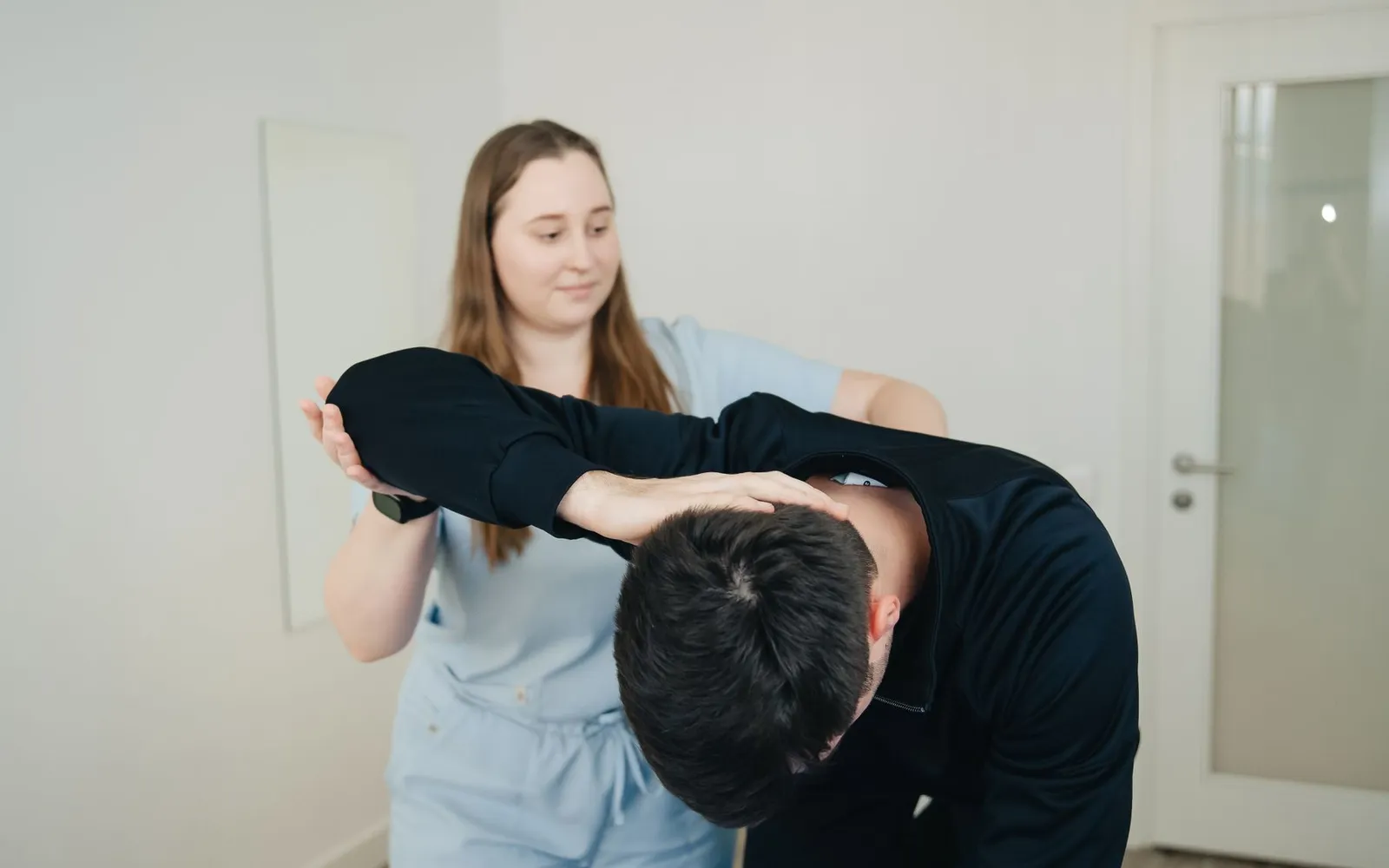
If it recurs a few times a year

A one-off stiff neck usually resolves on its own. The same neck stiffening up a few times a year says something else: the neck is constantly working at the edge of its capacity, and a small trigger — a bad pillow, cold weather, a tiring day — is enough to set it off.

Fizyoterapist Aydın Ali brings pain under control quickly with manual therapy during the acute phase, but doesn't end the process there. Upper-back mobility and deep neck-muscle control are measured; recurrence is only prevented by correcting these two areas. Pillow and screen setup aren't an add-on — they're part of the programme.

Why does it mostly happen in the morning?

During sleep the neck stays in one position for hours, and if that position is unfavourable the joints and muscles are held under a load they never meet during the day. A pillow that is too high or too flat, sleeping face down, cold air from an open window and tension built up the day before combine to produce the morning picture.

That is why pillow and sleeping position are taken seriously in the assessment. In a significant share of recurring stiff necks, this adjustment alone makes a noticeable difference.

Should I wear a collar?

A soft collar can feel comforting in the first hours, but used for days it slows recovery: neck muscles do not work while they are supported, and they weaken quickly. The same applies to complete rest.

Current practice is to start moving early, within what pain allows. Which movements are safe during the painful phase is decided at the assessment; the aim is not to protect the neck but to have it used in a controlled way.

If it keeps recurring, the cause may not be the neck

The same neck locking several times a year is no coincidence. The most common background is reduced mobility in the upper back together with weakness in the muscles that stabilise the shoulder blade: these two gaps shift the load of carrying the head onto the neck muscles, leaving the neck permanently working at the edge of its capacity.

In that case stretching brings temporary relief but does not end the problem. The programme therefore goes beyond the acute phase; upper back mobility and shoulder girdle strength are what actually change the picture.

How is it told apart from a cervical disc herniation?

With a stiff neck the pain sits in the neck and around the shoulder, changes markedly with movement, and there is no numbness travelling into the arm. With a cervical disc herniation the pain radiates down the arm and there may be numbness in the fingers or a weaker grip.

Because this distinction changes the direction of the programme, it is made at the first assessment. If there is numbness, weakness or loss of dexterity in the arm the approach differs, and progressive findings mean a medical assessment is requested.

When to see a doctor without delay

The great majority of stiff necks are not urgent. However, neck pain starting after a significant blow or road accident, neck stiffness with fever, sudden severe headache, difficulty speaking or swallowing, or widespread weakness in the arms or legs all require urgent assessment.

Fizyoterapist Aydın Ali screens for these specifically at the first assessment; if any are found you are referred to the appropriate doctor before physiotherapy begins.

5.0 · 22 Google reviews

Book a one-to-one assessment for stiff neck

Fizyoterapist Aydın Ali · Bursa Nilüfer. Share your complaint; we plan the process together after the assessment.

Frequently asked questions

How long does a stiff neck take to settle?

Most simple muscular and joint-related cases improve markedly between a few days and two weeks. Physiotherapy aims to shorten that and, more importantly, to prevent recurrence.

Should I use heat or cold?

Most people with muscular stiffness find heat helpful; cold may be preferred on the first day after a clear strain or blow. Either should be brief and comfortable, and never applied directly against the skin.

Is cracking my own neck harmful?

Forcing the turn yourself is not advised: it gives a moment of relief but re-strains the tissue that is already irritated and feeds the recurrence cycle. Manual techniques are applied after assessment, and only those judged appropriate.

Which pillow should I use?

There is no single correct pillow; what decides it is your sleeping position. Someone who sleeps on their back needs a thinner pillow, a side sleeper one full enough to fill the width of the shoulder. Sleeping face down is the most demanding position for the neck.

Other treatments

  • Neck Herniation

    A programme focused on posture and the deep neck muscles for pain spreading into the neck, shoulder and arm.

  • Straight Neck

    Assessment that reads the X-ray finding correctly, plus exercise targeting the deep neck muscles.

  • Back Pain

    For pain settling between the shoulder blades that builds through the day: a programme aimed at the source.

Articles on this topic

Book an appointment for Stiff Neck

The appointment form does not ask for health information; details are discussed by phone.

Book an appointment